I had a difficult conversation with a VP of M&A last week.
Not difficult in the sense that we disagreed — difficult in the sense that the stakes were high, the relationship was new, and the wrong signal could have ended the deal before it started.
I chose Zoom with video. On purpose.
Not because it was convenient. Because I needed to see his face.
The Channel Carries the Message
Most people pick a communication channel based on habit or convenience. Text is fast. Email is easy. Slack is already open. That’s not a strategy — that’s default behavior.
And in negotiation, default behavior costs you.
Every channel gives you a different set of tools — and strips away others. There are four layers of human communication: kinetic (body movement and posture), visual (facial expressions and eye contact), paralinguistic (tone, pace, and inflection), and linguistic (the actual words).
Face-to-face gives you all four. Zoom keeps visual and paralinguistic. Phone narrows it to tone and words. Text and email leave you with words alone — no emotion, no nuance, just interpretation.
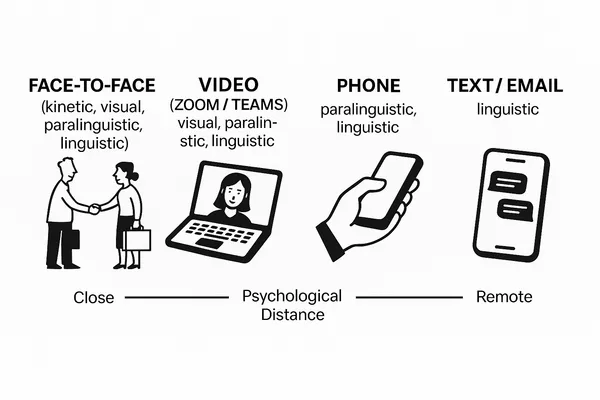
By the time you reach text or email, you’re down to one layer. And one layer is where misreads happen, relationships fracture, and deals quietly fall apart.
Psychological Distance Is a Strategic Variable
The further you move from face-to-face, the more psychological distance you create. Sometimes that’s intentional and useful — distance can reduce emotional friction in routine exchanges. But in high-stakes negotiations, distance costs you information you can’t get back.
"You can’t read a room through a reply-all."
The VP of M&A call went well. Not because I said the right things — because I could see when something landed wrong and adjust before it compounded. I watched his expression when I made a specific point. I matched my tone to what his face was telling me. I paused when the energy shifted.
None of that is possible over email. None of it.
Connection First. Efficiency Second.
Here’s the framework for channel selection across the arc of any negotiation:
Early stage — use proximity. In-person or video. You’re building trust, reading intent, and establishing credibility. You need all four communication layers working for you simultaneously.
Mid-stage — phone works once rapport is established. You keep tone and lose body language, but the relationship carries the gap if you’ve done the early work.
Late stage — email is fine when terms are aligned and you’re in documentation mode. That’s efficiency earned by the relationship you already built.
The mistake isn’t using text or email. The mistake is using them when the conversation actually matters.
Difficult conversations need to be seen to be heard. The channel you choose tells the other side exactly how seriously you’re taking what’s about to be said.
Choose accordingly.
Your negotiation style shapes how you read non-verbal signals — and how clearly you project your own. Find out where your wiring gives you an edge.